New Boston Historical Society
New Boston, New Hampshire

Patriot's Day photo taken by the author in 2024
New Boston in the American Revolution
This page is about New Boston, New Hampshire, during the war years 1775-1783, and it will be updated over time. Men from New Boston fought at Bunker Hill, Bennington, and Saratoga, among other famous battles, and we'll tell their stories. Some, like John McNeil, fought at sea. The women and children at home have their stories, too.
New Boston received its charter from King George III in 1763. How many people lived in our town when the war began, twelve years later? A census was conducted soon after Lexington & Concord:
| Inhabitants of New Boston in 1775 | |
|---|---|
| 164 | men (boys) under 16 |
| 118 | men 16-50 (eligible to serve in the militia) |
| 27 | men over 50 |
| 256 | women of all ages (compared to 309 men of all ages) |
| 4 | slaves |
| 569 | TOTAL |
Two Stories from the New Boston Cemetery

Dickey's obelisk is opposite the Town Tomb, while Lamson's stone is between the Tomb and the Hearse House.

The Boston Tea Party happened from 6:00-9:00pm in December darkness.
After the war began, Lamson fought at sea and in the Battle of Bennington in 1777. He married Sarah Patch in 1784 and moved to New Boston, where they had six children.

Redcoats at Concord watching out for Elias Dickey
The Association Test

New Boston was the least patriotic town in New Hampshire.
62 men signed the Association Test in our town; however 47 did not, which meant that 43% of New Boston men remained loyal to King George, the highest percentage of Loyalists of any NH town.
The lists of names of signers and non-signers show divisions between Loyalists and Patriots within individual families. In future months we will explore the consequences of refusing to declare oneself a Patriot, and tell the story of the Loyalist doctor imprisoned for helping the British.
Patriot's Day — April 19, 2025

Photos from Patriot's Day reenactments in 2024 and 2013
For more information about Patriot's Day 2025 please see:
https://www.nps.gov/mima/planyourvisit/patriots-day.htm

New Boston reenactor Dick Moody near Lexington, Patriot's Day 2015
The Battle of Bunker Hill — June 17, 1775
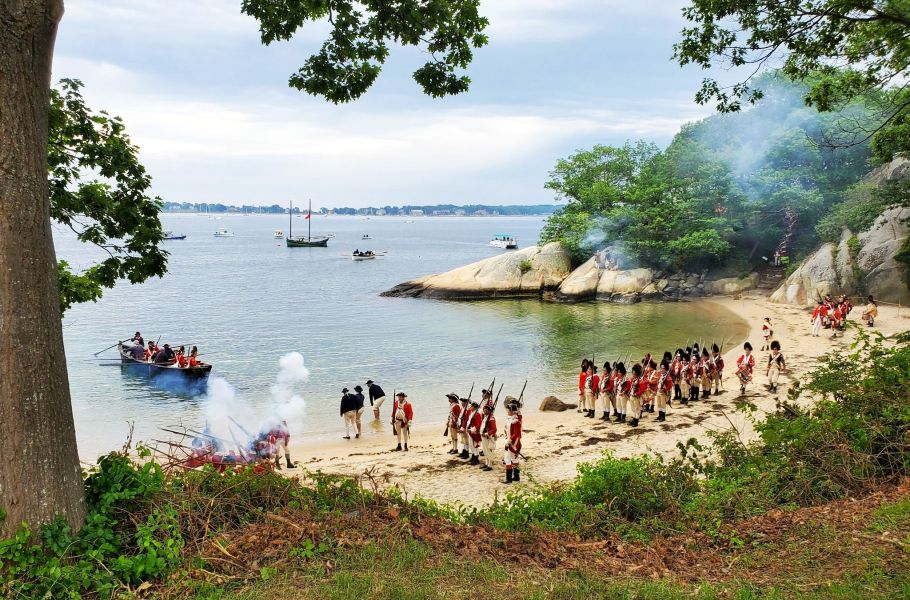
Photo from the reenactment of the Battle of Bunker Hill in Gloucester MA, June 2025
Who were the two dozen New Boston men who fought at Bunker Hill? William Livingston was a blacksmith, Elijah Cochran was a tailor, and Robert Livingston was a carpenter. Most of the others were "husbandmen" or farmers — none were professional soldiers. Fifty-year-old John Burns had served during the French and Indian War, but the younger men had never fired a musket in battle.
Their commander, Colonel John Stark, saw that the American left flank was unprotected and ordered his men to build a barricade while waiting for the British to attack. Stark pounded a wooden stake into the ground thirty yards in front of the fence, telling his men not to fire until the redcoats were in range so they wouldn't waste their gunpowder. The British soldiers had to charge uphill across fields of uncut hay that hid obstacles like fences and stone walls, and their first and second assaults were repelled by volleys of musket fire. However, the miltiamen were now running out of ammunition. The British soldiers had bayonets with which to fight, but the Americans did not, so they picked up rocks and threw them at the enemy, and then they turned and ran..
By 5:00PM on June 17, 1775, the British had chased the militiamen from Charlestown at a cost of a thousand dead and wounded, two times the American losses. British General Henry Clinton wrote in his diary, "A few more such 'victories' will put an end to British dominion in America."
Our records indicate that no New Boston men were killed or wounded at Bunker Hill, and more than a few went on to fight under General John Stark at Bennington and Saratoga.